

BIS Toy Certification India: 2026 Distributor Guide
Mandatory BIS rules under the Toys QCO 2020, IS 9873, IS 15644, and exactly what to verify before placing your first order with a manufacturer.
If you are sourcing, importing, or distributing toys in India in 2026, BIS certification is not optional. The Toys (Quality Control) Order 2020 makes the BIS Standard Mark (ISI mark) mandatory for every toy intended for children under fourteen, whether the product is manufactured domestically or imported. This guide explains exactly what compliance looks like, which Indian Standards apply, the supplier checks distributors should perform before signing on a new manufacturer, and the operational signals that separate a credibly certified factory from one taking shortcuts.
What the Toys (Quality Control) Order 2020 actually requires
The Order, notified by the Department for Promotion of Industry and Internal Trade (DPIIT), came into effect on 1 September 2020 and has been amended several times since. Its operative clause is simple: no person may manufacture, import, sell, distribute, store, lease, hire, or display for sale any notified toy in India unless that toy conforms to the applicable Indian Standard and bears a valid BIS Standard Mark (the ISI mark) under licence from the Bureau of Indian Standards.
In practice, the Order covers the entire supply chain. A retailer cannot sell an uncertified toy. A distributor cannot warehouse one. An importer cannot bring one through customs. Every link in the chain inherits the manufacturer's compliance status, which is why supplier verification is the single most important step a distributor can take when onboarding a new brand.
Which Indian Standards apply
Two primary standards govern toy safety in India, and both are aligned with international ISO and IEC norms so a BIS-certified toy is also competitive in export markets.
IS 9873 — non-electric toys
IS 9873 (Part 1): 2018 covers mechanical and physical properties: sharp edges, small parts and choking hazards, sharp points, tension and torque limits, and structural integrity. Subsequent parts of IS 9873 cover flammability (Part 2), specific element migration including heavy metals such as lead, cadmium, and barium (Part 3), experimental sets for chemistry (Part 4), chemical toys other than experimental sets (Part 5), and certain ester limits (Part 9). The full series mirrors ISO 8124 so a manufacturer running disciplined IS 9873 testing is also production-ready for European EN 71 and US ASTM F963 buyers.
IS 15644 — electric toys
IS 15644: 2006 covers electric toys and is identical with IEC 62115. Any toy with a battery, motor, sound chip, or light circuit falls under this standard. The required tests cover electrical safety, temperature rise, mechanical strength of the housing, transformer characteristics for mains-powered models, and labelling.
BIS publishes amendments and revised editions periodically. The Order specifies that the latest version of each standard, as notified by BIS from time to time, applies — so a contract that pins compliance to a specific year of the standard rather than to "the current edition" can leave a distributor exposed if the standard is updated mid-shipment.
What changed in the 2026 extension
In late 2024 the Government issued an omnibus extension under which several quality control orders, including the Toys QCO, were updated and the certification cycle continued through September 2026. The practical takeaway for distributors is that compliance is not a one-time event — manufacturers must maintain their BIS licence, renew it on schedule, and remain audit-ready. Ask any prospective supplier when their current BIS licence was issued and when it expires, and verify the answer against the BIS public licence database.
How a BIS-certified toy is actually tested
BIS certification follows a defined sequence. A manufacturer first identifies which Indian Standards apply to each SKU, then submits product samples to a BIS-recognised laboratory. Common test categories include:
- Mechanical and physical — choking hazard parts, sharp edges, drop and impact tests, small parts cylinder checks for under-3 toys, projectile energy limits
- Chemical — phthalate limits, soluble heavy metal migration, formaldehyde release for textile toys
- Flammability — burn rate of textiles, costumes, and plush
- Electrical — temperature rise, insulation, battery short-circuit, transformer integrity (electric toys only)
- Labelling and packaging — age grade, manufacturer details, BIS licence number, ISI mark placement
After lab clearance, BIS conducts a factory inspection covering raw material control, in-process inspection, calibration of measuring equipment, batch traceability, and final release procedures. Only then is a licence granted, after which the manufacturer can apply the ISI mark to product packaging and the toy itself.
What distributors should verify before placing the first order
A surprising number of distributor onboarding mistakes stem from accepting a manufacturer's claim of "BIS certified" without verifying the specifics. Before placing your first order, ask for:
- The BIS licence number for the specific product category you are buying — a furniture-toy licence does not cover a soft toy, and an electric-toys licence does not cover non-electric SKUs
- The applicable Indian Standard(s) the licence covers, including part numbers (for example IS 9873 Part 1, Part 2, and Part 3 for a typical plastic toy)
- A current BIS test report from a recognised laboratory, dated within the last twelve months
- Sample packaging showing the ISI mark applied with the licence number visible and a clearly stated age grade
- Confirmation that the manufacturer's factory has been audited by BIS in the current licence cycle
- A documented batch release procedure describing how each production batch is sampled, recorded, and signed off before dispatch
Operational signals of a credibly certified factory
Beyond the documents, certain operational behaviours separate a manufacturer running BIS as a working quality system from one treating it as a paperwork exercise. Look for:
- A dedicated quality team, not just a single "QC manager"
- Calibrated test equipment with calibration certificates on display
- Written SOPs for each line, dated and version-controlled
- A complaint and recall log maintained over multiple years
- Willingness to share an annual production volume figure and a defect-rate trend line
- Sample storage for traceability — typically 12 to 24 months of retained samples per SKU
A factory that can answer the first question but not the third is using BIS as marketing. A factory that can show you all six is treating compliance as an operating system, which is exactly what a distributor wants to ride on.
What the ISI mark on packaging should look like
The ISI mark is the visible signal to retailers, regulators, and end customers. On a compliant toy package you should see the ISI mark itself, the BIS licence number in the format CM/L-1234567890, the applicable Indian Standard with its part number, the manufacturer name and address, and an age grade. A package missing any of these elements is a red flag — both for legal exposure and as evidence the manufacturer's artwork pipeline is undisciplined, which usually correlates with weaker production discipline overall.
How BIS certification connects to export readiness
For Indian manufacturers selling into export markets, BIS discipline is the foundation that makes EN 71 (Europe) and ASTM F963 (United States) certification straightforward. The mechanical and chemical test logic is highly aligned across these regimes, so a factory running rigorous IS 9873 testing typically only needs targeted additional testing — not a parallel quality system — to qualify for European or American buyers. Distributors building a national network should look for manufacturers that already export, because the same product discipline that earns export buyers also reduces retail returns and customer complaints in domestic stores.
Frequently asked questions
FAQ
Is BIS certification mandatory for all toys sold in India?
Yes, for any toy intended for use by children under fourteen years of age. The Toys (Quality Control) Order 2020 covers domestic manufacture, import, distribution, sale, and display. Customs will not clear an uncertified import shipment, and state enforcement officers can seize uncertified stock from retail shelves.
Can I import an uncertified toy if I plan to certify it after arrival?
No. BIS certification must be in place at the time of import. The licence is held by the manufacturer (whether Indian or foreign) and applies to the product before it ships. There is no in-country post-arrival certification route under the current Order.
How long does BIS certification take for a manufacturer?
A clean process — assuming the product passes lab testing on the first attempt and the factory passes its audit — typically takes three to five months from sample submission to licence grant. Manufacturers with prior certifications usually move faster because BIS inspectors recognise their quality system.
Do toys made for export from India also need BIS?
No, the Order applies to toys placed on the Indian market. However, most BIS-certified manufacturers maintain export certifications in parallel because the underlying test work is largely the same.
What happens if a non-compliant toy is found in retail?
Penalties under the BIS Act include fines and imprisonment for repeated or wilful non-compliance, plus seizure of stock. Brand reputation damage is usually the bigger commercial cost — Indian retailers move quickly to delist non-compliant suppliers because their own licences and trust signals are exposed.
Working with Funtastique on BIS-certified supply
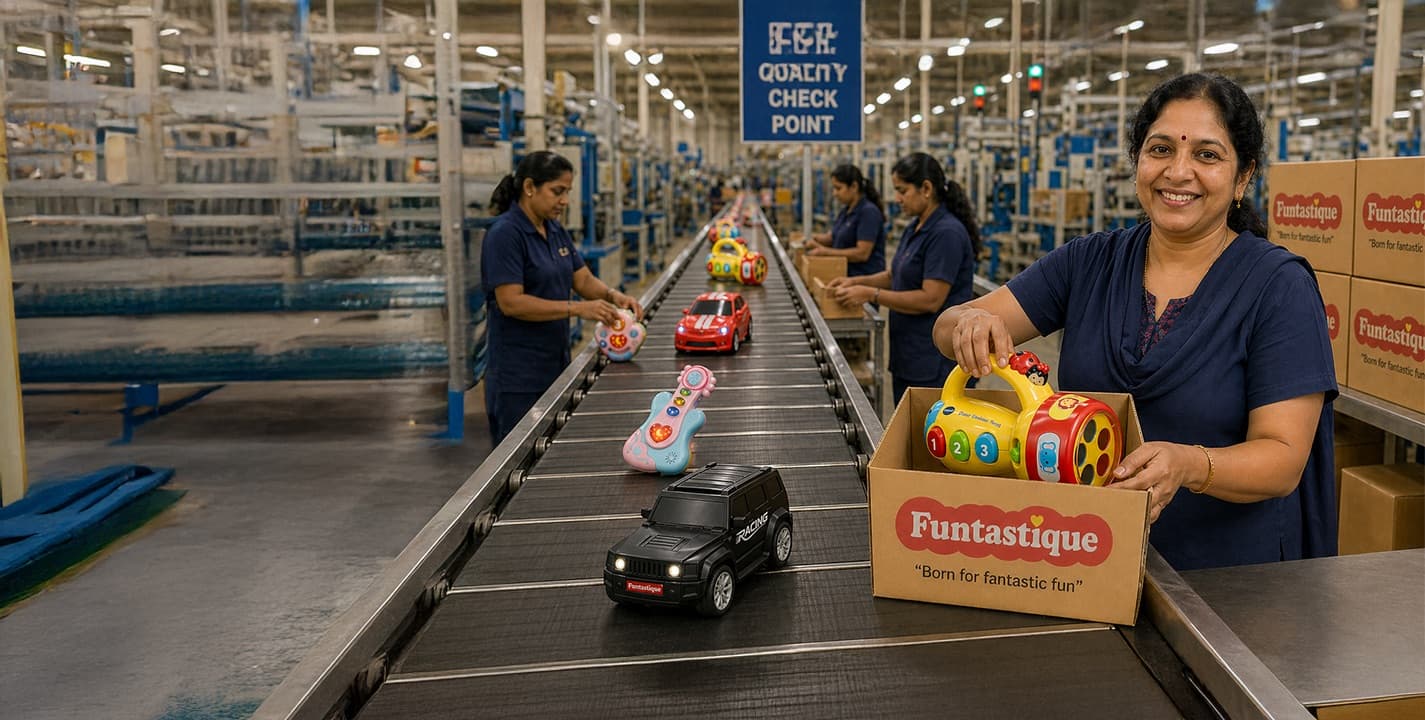
Every Funtastique SKU is manufactured in our Pune facility under a current BIS licence with documented batch testing, sealed sample retention, and per-shipment compliance packs. Distributors onboarding with us receive the licence numbers, test reports, and sample artwork upfront — not after asking. If you are evaluating a distributor relationship and would like to review our compliance documentation, request our distributor pack or contact the team and we will share the relevant licence and test paperwork before any commercial discussion.
Reach out for catalogue requests, distributor conversations, or manufacturing questions.