

Toy Packaging in India: 2026 Shelf Design Guide
How disciplined toy packaging — clarity, shelf appeal, age signalling, durability — drives 15-30% sell-through lift in Indian retail.
Indian retail buyers decide which SKUs to keep on shelf in seconds. Parents browsing the toy aisle decide which package to pick up in seconds. Gifting customers — usually with less category knowledge than parents — decide in even fewer seconds. Toy packaging is the first sales conversation a product has with each of these audiences, and it is also where the largest single sell-through lift is available without changing the product itself. This piece breaks down what disciplined packaging actually looks like in 2026, why it matters more in India than in many other markets, and what distributors and retailers should verify before approving a manufacturer's artwork.
Why packaging is over-leveraged in the Indian market
Three structural features of Indian toy retail make packaging more decisive than in many comparable markets.
Discovery still happens at retail, not online
About 60 percent of Indian toy purchases happen in physical stores, and parents specifically prefer to examine toys before buying. This means the physical package has to do the persuasion that an Amazon listing might do elsewhere. There is no zoom function, no scrollable image gallery, no review summary — just the box and the seconds the shopper gives it.
Gifting drives a large share of volume
Gifting transactions are dominated by buyers with limited category knowledge — grandparents, aunts, uncles, corporate gifters. Their decision relies almost entirely on the visual signals on the package: age suitability, perceived quality, and "this looks like it makes a good gift." A poorly-designed package costs a brand the gifting purchase entirely because the gifter cannot risk handing over a box that does not look polished.
Tier 2-3 retail has limited counter staff knowledge
In most non-metro independent toy stores, the counter staff is not deeply trained on individual SKUs. The package has to communicate enough — what the toy is, who it's for, what it does — that the staff can sell it without product knowledge they may not have. A package that requires explanation cannot be sold by a stand-in cashier on a Sunday afternoon.
The five things every toy package has to communicate in three seconds
A well-designed toy package answers five questions before the shopper has consciously processed reading anything:
1. What is this?
A clear product visual — typically the toy in use, not a flat catalog shot. Lifestyle imagery converts better than studio imagery in toy categories because parents project their child into the scene.
2. Who is it for?
Age grade prominently displayed. "3+", "Ages 6-9", or similar — large enough to read from one metre away. This is non-negotiable for both compliance (BIS labelling requires age suitability) and sales conversion. Gifting buyers will not pick up a package they cannot quickly verify is age-appropriate.
3. What does it do?
A short feature line — three to five words. "Bubble blaster, continuous output." "Educational construction set, 80 pieces." "Remote-control rally car, 15 mins charge." This is the single line the gifter will use to justify the purchase to themselves.
4. Is it any good?
Trust signals — BIS certification mark visible, brand logo with established equity, a single review quote or rating if available, and crucially the manufacturer name and address in legible type. Indian buyers in 2026 actively seek "Made in India" call-outs and BIS marks; the absence of either reads as a quality risk.
5. Is it complete?
A clear "what's in the box" callout — number of pieces, accessories included, batteries-included or not. The most common gifting return reason is "I expected more" — a transparent contents list prevents the disappointment.
Shelf appeal — design moves that consistently lift sell-through
Beyond the five questions above, four design choices reliably correlate with stronger sell-through:
Vertical hierarchy that reads top-down
Brand at top → product visual in centre → feature line and age below → trust marks at bottom. Shoppers scan packaging top-to-bottom and side-to-side; the hierarchy needs to surface the most decision-relevant information in the natural scan path.
Strong colour contrast against shelf neighbours
A package designed in isolation often disappears on a busy shelf. The right test is to put a sample on a shelf with five to ten competing packages and stand back two metres — if the package does not pop, it loses the impulse buy.
Window-cut or visible toy element
Packages that show the actual toy through a transparent window or a partial cut-out consistently outperform fully-printed boxes for under-3 categories where parents want to see the product, and for plush where touch verification matters. The trade-off is structural strength and freight risk, which the design has to mitigate.
Festive-mode artwork variants
Markets like India reward seasonal artwork. A package with a small Diwali ribbon graphic from October-November, or a Christmas wreath in December, signals "this is a current, gift-ready product" and lifts gifting conversion. The cost is low — typically a sticker run rather than a full re-print.
Durability — the unsexy multiplier
A beautiful package that arrives crushed costs the sale more reliably than a plain package that arrives intact. Three durability checks distributors should require:
- Drop test — the manufacturer should be able to show a documented drop test to one metre on each face. Packages that fail this in production typically also fail it during retail handling and last-mile delivery.
- Stack strength — pallet stacking simulates retail backroom storage. A box that crushes under three layers in test will crush under one layer in a humid Mumbai monsoon warehouse.
- Print abrasion resistance — finger-rubbing on retail shelves over weeks degrades cheap inks visibly. A scratch test on the printed surface within the first 24 hours of arrival flags this risk early.
A package that survives the supply chain, retail handling, and a few weeks on shelf without scuffs is a package the customer will pick up confidently. The opposite — even slightly damaged or visibly degraded — flags risk and the customer chooses the neighbour.
Sustainability — the rising premium
68 percent of B2B retail buyers in India now prioritise eco-friendly packaging materials, and the share is rising. Manufacturers and distributors should expect:
- Recycled paper-based packaging to become the default for non-electronic toys by 2027
- FSC certification to start appearing in retailer specification sheets in metro and tier-1 markets
- Reduced plastic blister in favour of paper-and-window combinations
- "Recyclable", "biodegradable", or "FSC-certified" call-outs to drive measurable lift in metro and educated buyer segments
For premium and gifting tiers, sustainability messaging is now a competitive necessity rather than a nice-to-have.
What distributors should verify before accepting a manufacturer's artwork
Most distributor pain on packaging comes from approving artwork without checking the basics. The discipline:
- Compliance audit — ISI mark visible, BIS licence number printed, age grade prominent, manufacturer name and address legible, country of origin stated, weight and dimensions on outer carton
- Translation check — Hindi or regional language compliance on warning text where required
- Barcode test — print and scan it; barcode failures in retail are a recurring root cause of shelf-out and cause cashier abandonment
- Drop test sample — physical sample of the production package, dropped, stacked, and observed before the run is approved
- Shelf simulation — the package on a shelf with competitive neighbours, viewed from two metres, photographed for the team review
A 30-minute pre-approval checklist saves a 30-day production-correction cycle.
FAQ
How much does packaging affect toy sell-through in Indian retail?
Direct sell-through lift from disciplined packaging is typically 15-30 percent versus a poorly-designed equivalent at the same price point, holding product quality constant. The compounding lift across reorders, retailer placement preference, and gifting share can be considerably higher.
What information must legally appear on toy packaging in India?
Under BIS labelling rules: ISI mark, BIS licence number, manufacturer/importer name and address, country of origin, age grade, product specifications including dimensions and weight, batch and date code, and required warning statements (e.g., choking hazard for under-3 categories where applicable).
Should I use plastic blister or paper-based packaging?
Paper-based wherever the product physics allow it. Blister packaging carries a sustainability and shelf-perception penalty in 2026 that did not exist five years ago, and Indian retailers are increasingly weighting eco-friendly packaging in shelf placement decisions.
How do I evaluate whether a manufacturer's packaging is shelf-ready?
Two tests. First, place one sample on a real shelf next to five to ten competitive packages and stand back two metres — does it pop? Second, run a 30-second household test: hand the package to someone who does not know the brand and ask them to tell you what the toy is, who it's for, and what it does. If they need more than 30 seconds, the package is not shelf-ready.
What is the typical cost difference between basic and premium packaging?
Premium packaging adds roughly 8-15 percent to landed cost on a mid-priced toy (₹200-1,500 retail). The sell-through lift typically more than offsets it within the first replenishment cycle on volume SKUs. For pure gifting SKUs, premium packaging is usually a structural requirement rather than an upgrade option.
Packaging discipline at Funtastique
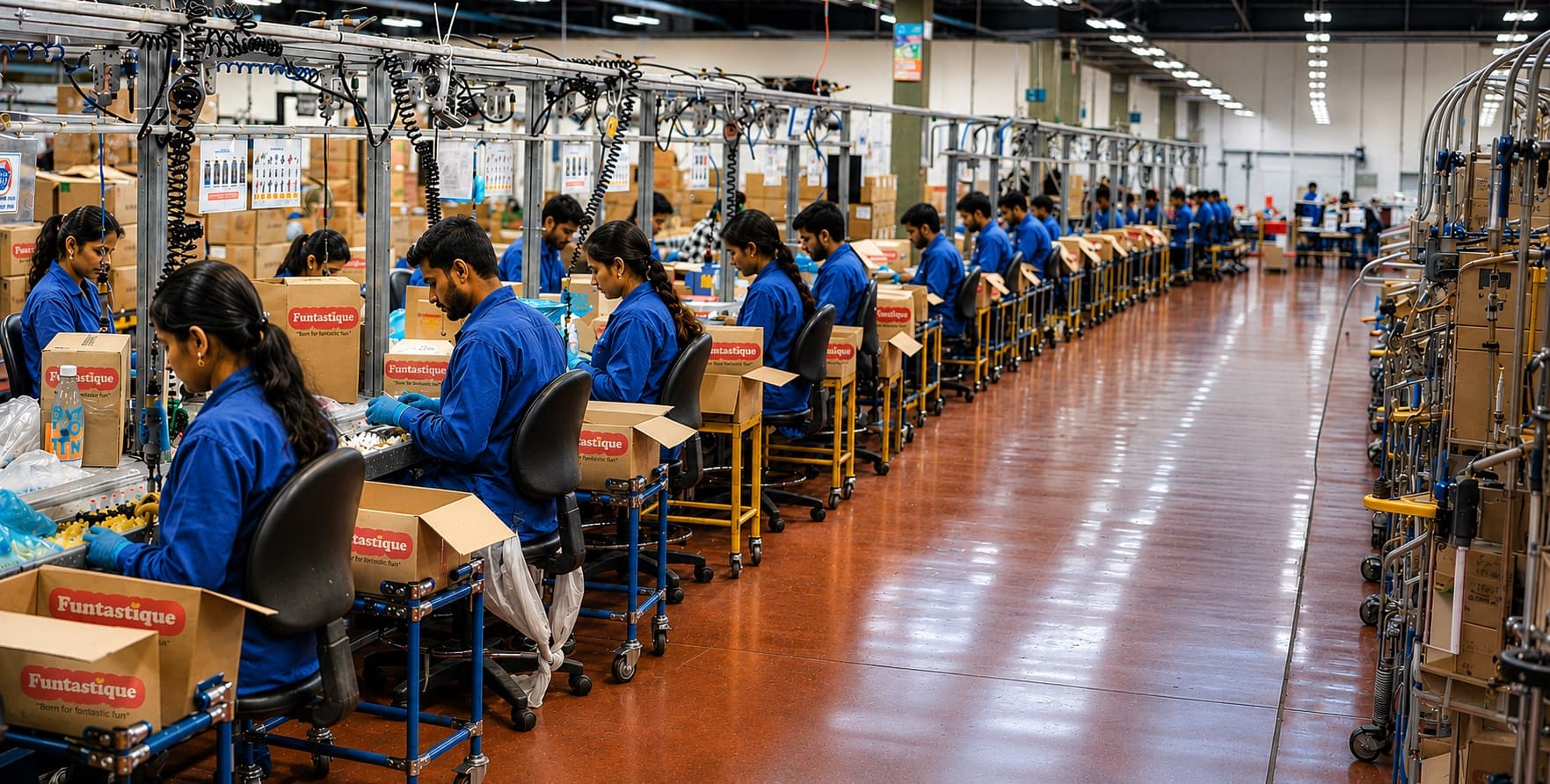
Every Funtastique SKU ships with shelf-ready packaging designed for Indian retail conditions: clear age grade, visible BIS mark and licence number, lifestyle imagery, drop-tested durability, and festive artwork variants for our top 20 SKUs each year. We share artwork samples and structural prototypes with distributor partners before production. To see our packaging samples and review the full distributor pack, apply to the partner program or contact our team.
Reach out for catalogue requests, distributor conversations, or manufacturing questions.